
Difference Between Acord Forms and Carrier Specific Forms
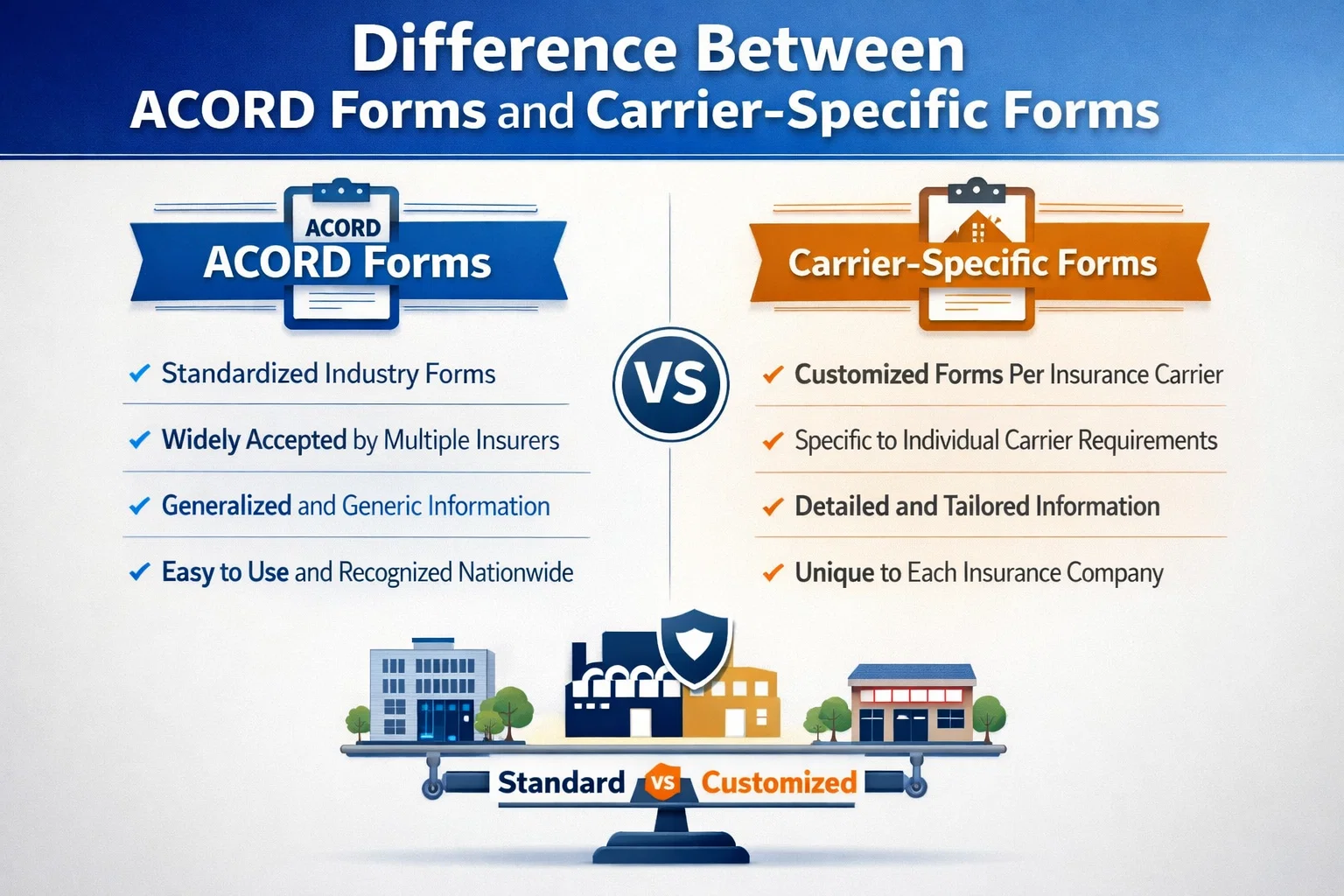
In the insurance industry, accurate documentation is necessary for clear communication among agents, brokers, insurance carriers, and policyholders. Two widely used document types are Acord forms and carrier-specific forms. Although both serve important purposes, they are not the same and follow different standards. Using them correctly requires a clear understanding of how they differ and when each is required.
This article explains the difference between Acord forms and carrier-specific forms, outlines their respective roles, and highlights why selecting the appropriate form is important for maintaining accuracy, meeting compliance requirements, and ensuring efficient insurance transactions.
What Are Carrier-Specific Forms?
Carrier-specific forms are insurance documents created and required by individual insurance companies. These forms are designed to meet a carrier’s internal underwriting guidelines, product offerings, and compliance requirements.
Unlike Acord forms, carrier-specific forms are not standardized across the industry. Each carrier designs its own forms to collect information they consider necessary for evaluating risk, issuing policies, or processing endorsements.
Characteristics of Carrier-Specific Forms
- Created by individual insurance carriers
- Required only by the insurance carrier
- Focused on carrier-specific underwriting requirements
- Often more detailed than Acord forms
- They may include proprietary questions or discussions
These forms are commonly used alongside Acord forms or after an initial submission has been reviewed.
Differences Between Acord Forms and Carrier-Specific Forms
1- Standardization vs. Customization
Acord forms are standardized and designed for use across the insurance industry. The same Acord form can be submitted to multiple carriers with minimal adjustments.
While carrier-specific forms are customized, each carrier decides what information is required, how it should be presented, and when the form must be used.
2- Acceptance Across Carriers
Most insurance companies generally accept Acord forms. They act as a universal starting point for insurance applications and policy servicing.
Carrier-specific forms are accepted only by the issuing carrier. Submitting a form to another insurer is usually not allowed.
3- Purposes and Use Case
Acord forms are usually used for:
- Initial insurance applications
- Policy changes and endorsements
- Certificates of insurance
- Claim reporting
Carrier-specific forms are typically used for:
- Special underwriting requirements
- High-risk or niche coverages
- State-specific compliance
- Supplemental disclosures
In many cases, carriers require both an Acord form and one or more carrier-specific forms to complete the underwriting process.
4- Level of Detail
Acord forms focus on collecting general and standardized information, such as business details, coverage limits, loss history, and exposure data.
5Carrier-specific forms often request additional or more detailed information, such as:
- Internal risk classification
- Detailed operational procedures
- Unique safety protocols
- Carrier-specific exclusions or endorsements
5- Flexibility
Acord forms allow agents to work efficiently by reusing the same form structure for different carriers. This saves time and reduces errors caused by re-entering data.
Carrier-specific forms reduce flexibility because agents must complete different forms for different carriers, even when the underlying information is similar.
6- Regulatory and Compliance
Acord forms are designed to meet general regulatory standards but may not cover every state-specific or carrier-specific requirement.
Carrier-specific forms often address:
- State-mandated disclosures
- Carrier complicane policies
- Legal language approved by the carrier
Final Words
The difference between Acord forms and carrier-specific forms comes down to standardization, purposes, and scope. Acord forms follow an industry-wide format that promotes consistency, efficiency, and clear communication among agents and insurers. Carrier-specific forms, by contrast, are designed to meet the individual underwriting, compliance, and operational requirements of a specific insurance company.
Both forms play an important role in the insurance process. Acord forms simplify information sharing, while carrier-specific forms provide the detailed and precise data insurers need to make informed decisions. When used together appropriately, they support a more efficient, accurate, and reliable policy application and management process.